VIM
Visual Instruction Mode
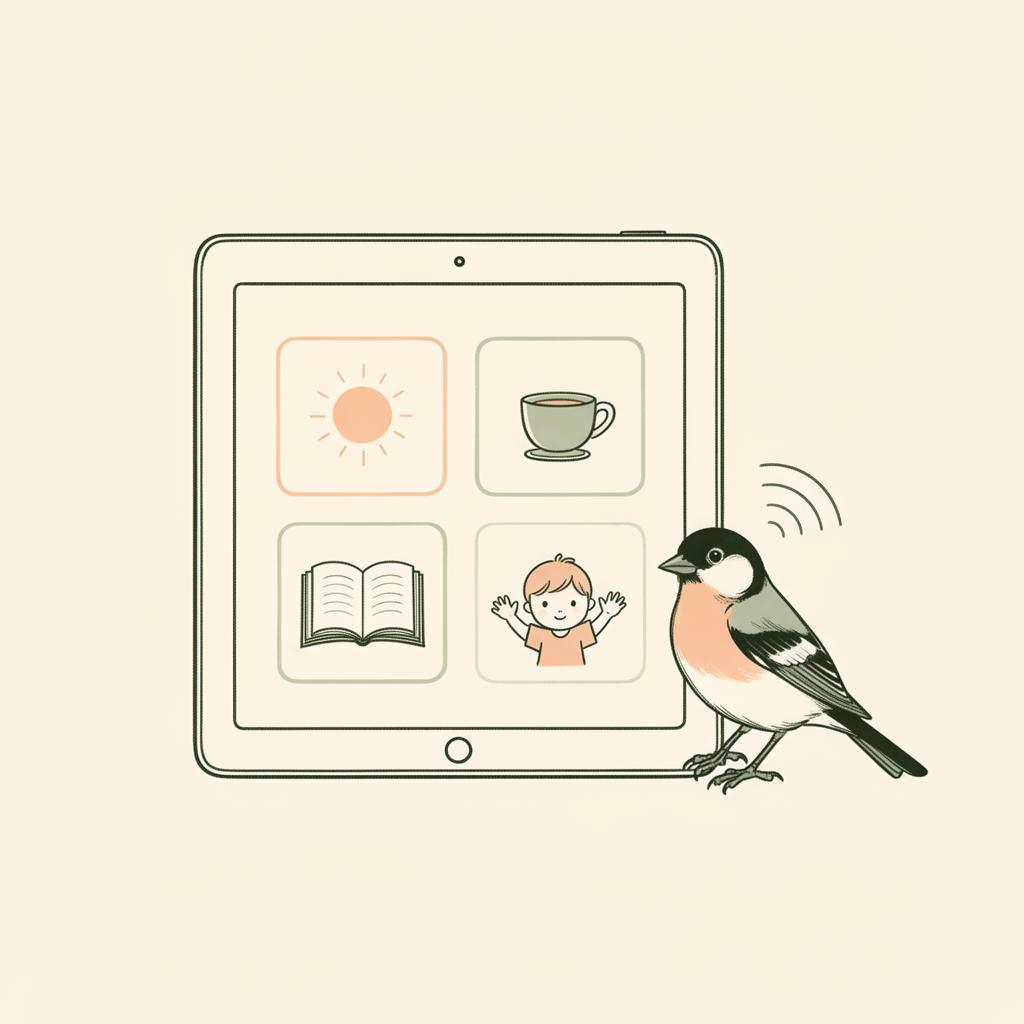
Visuals that support understanding of directions, concepts, routines, and spoken language.
Little Finch is the new home of VIS, a research-informed visual language framework that helps neurodivergent learners communicate, connect, and participate through visual language.
The Visual Immersion System (VIS) is a flexible framework that uses visual supports to help learners acquire and use language. VIS is individualized to each learner and can be used across therapy sessions, classrooms, daily routines, and collaborative care teams.
Teams assess a learner's communication profile, match appropriate visual supports, implement those tools in real therapy, classroom, play, and routine settings, then adjust supports as learners grow.
VIS is built for schools, clinics, educators, clinicians, care teams, neurodivergent learners, and families who need communication supports that go beyond spoken words alone.
VIS was developed by Dr. Howard C. Shane at Boston Children's Hospital and is grounded in decades of clinical research on visual language and communication.
Contact Little Finch to request a demo, discuss partnerships, or learn more about VIS.
Improving communication, learning, and engagement for autistic and neurodivergent individuals.
VIS helps schools, clinics, and families turn visual strengths into stronger communication, deeper learning, and more meaningful participation.
Announcement
We're building the next chapter of VIS with a more connected experience for schools and clinics.

The Visual Immersion System™ / VIS™ is a research-informed, technology-supported framework developed at Boston Children's Hospital to support communication and learning for autistic individuals and others with developmental differences.
Built on more than 20 years of clinical work and research, VIS uses dynamic assessment to identify patterns of attention, engagement, receptive language, and expressive language. Those insights guide individualized visual supports for therapy, classrooms, daily routines, and participation.
Make directions, concepts, routines, and relationships more concrete and accessible.
Support requesting, commenting, answering, asking questions, and sharing ideas.
Help learners understand sequences, transitions, schedules, routines, and what comes next.
The framework helps teams understand how each individual learns, then adapt tools and environments to support participation.
VIS begins by understanding how an individual attends, engages, understands, and expresses language. The VIS Developmental Framework helps teams identify where a learner falls on the visual language spectrum and choose supports that fit.
Identify attention, engagement, receptive language, expressive language, and current communication patterns.
Choose visual supports and technology-supported tools that fit the learner's profile.
Use VIS tools across therapy sessions, classrooms, routines, and everyday activities.
Reassess and adjust supports as communication needs change.
Visual language spectrum

VIS organizes visual supports into three practical modes that help teams turn assessment into action.
Visuals that support understanding of directions, concepts, routines, and spoken language.
Visuals that support communication, including requests, comments, answers, questions, and participation.
Visuals that support schedules, transitions, sequences, activity structure, and what comes next.
VIS includes practical visual supports and training materials selected around each learner's assessment, goals, and daily routines. Tools may include photographs, videos, static and dynamic scene cues, topic displays, visual schedules, transition supports, goal examples, and therapy materials.
The library is more than a collection of resources. It helps teams choose the right supports for real therapy sessions, classrooms, and everyday care.
Static scene cues
Dynamic scene cues
Visual scene displays
Topic displays
Animated graphics
Visual schedules
Countdown and transition supports
Goal and treatment planning
Training materials
AAC-adjacent supports
VIS is designed for the full team supporting communication and learning, including SLPs, OTs, teachers, associate teachers, clinical leaders, caregivers, and partner organizations.
Bring a shared visual language framework into classrooms and school teams. VIS supports participation throughout the day, not only during speech sessions.
Bring VIS to your schoolUse VIS across assessment, therapy planning, treatment sessions, parent collaboration, and interdisciplinary care.
Bring VIS to your clinicLittle Finch is building a connected ecosystem of tools that support communication, learning, and developmental care.
Partner with Little FinchMake language, expectations, and routines easier to understand.
Help learners make choices, follow routines, and participate more confidently.
Give educators, clinicians, and caregivers a shared framework.
Support communication across people, activities, and settings.
VIS is grounded in clinical work and research on visual language, AAC, visual supports, scene cues, animated symbols, and technology-supported communication for individuals with autism and developmental differences.
VIS-specific publications describe a visual language framework across instruction, expression, and organization.
Visual supports and aided AAC strategies are widely used to support communication, comprehension, participation, and daily routines.
Research on visual scene displays, animation, scene cues, and mobile technology supports the use of meaningful visual information in communication intervention.
The references below include VIS-specific publications and related work in visual supports, AAC, visual scene displays, animated symbols, and technology-delivered communication supports.
This reference list is not exhaustive and is provided for informational purposes. VIS is a clinical framework and should be implemented by trained professionals using individualized clinical judgment.
Tell us about your setting and the learners you support. We will follow up to discuss VIS training, implementation, and partnership options.
hello@littlefinch.org